May 2026 Edition
E-CACS May 2026 Newsletter
Registration opens for the E-CACS 2026 Annual Symposium on June 6 at Rutgers (45 Years of Excellence), a member highlight on Dr. Lijuan Wang of Alexion AstraZeneca Rare Disease, academic news on humanized FcRn mouse models and a new molecular fingerprint for AI, and an industry roundup spanning molecular AI, cosmetics & personal care, biocatalysis, and pharma deals from Novo Nordisk, UCB, the FDA, and BMS–Hengrui.
Editor's Note
Chief Editor: Guangru Mao
Welcome to the May 2026 issue of the E-CACS Newsletter. As our annual symposium approaches, we would especially like to encourage members, colleagues, students, and friends to register for the E-CACS 2026 Annual Symposium on June 6 at Rutgers University. This year's meeting celebrates the 45th anniversary of E-CACS and will feature keynote lectures, technical sessions, career development activities, poster presentations, and networking opportunities across multiple chemistry-related industries.
This issue also includes a member highlight featuring Dr. Lijuan Wang of Alexion AstraZeneca Rare Disease, recognizing her long-standing contributions to pharmaceutical research and to the E-CACS community.
In our "What's New in Chemistry" section, we continue broad coverage of academic research and industrial innovation spanning pharmaceuticals, biotechnology, cosmetics & personal care, molecular AI, and process & R&D innovation. We are also pleased to continue the Molecular AI section for a second month, reflecting growing interest in AI-enabled molecular design, polymer informatics, and digital R&D tools across the chemical sciences.
Finally, we would like to thank Precise PEG for its generous support of E-CACS.
What's New in E-CACS
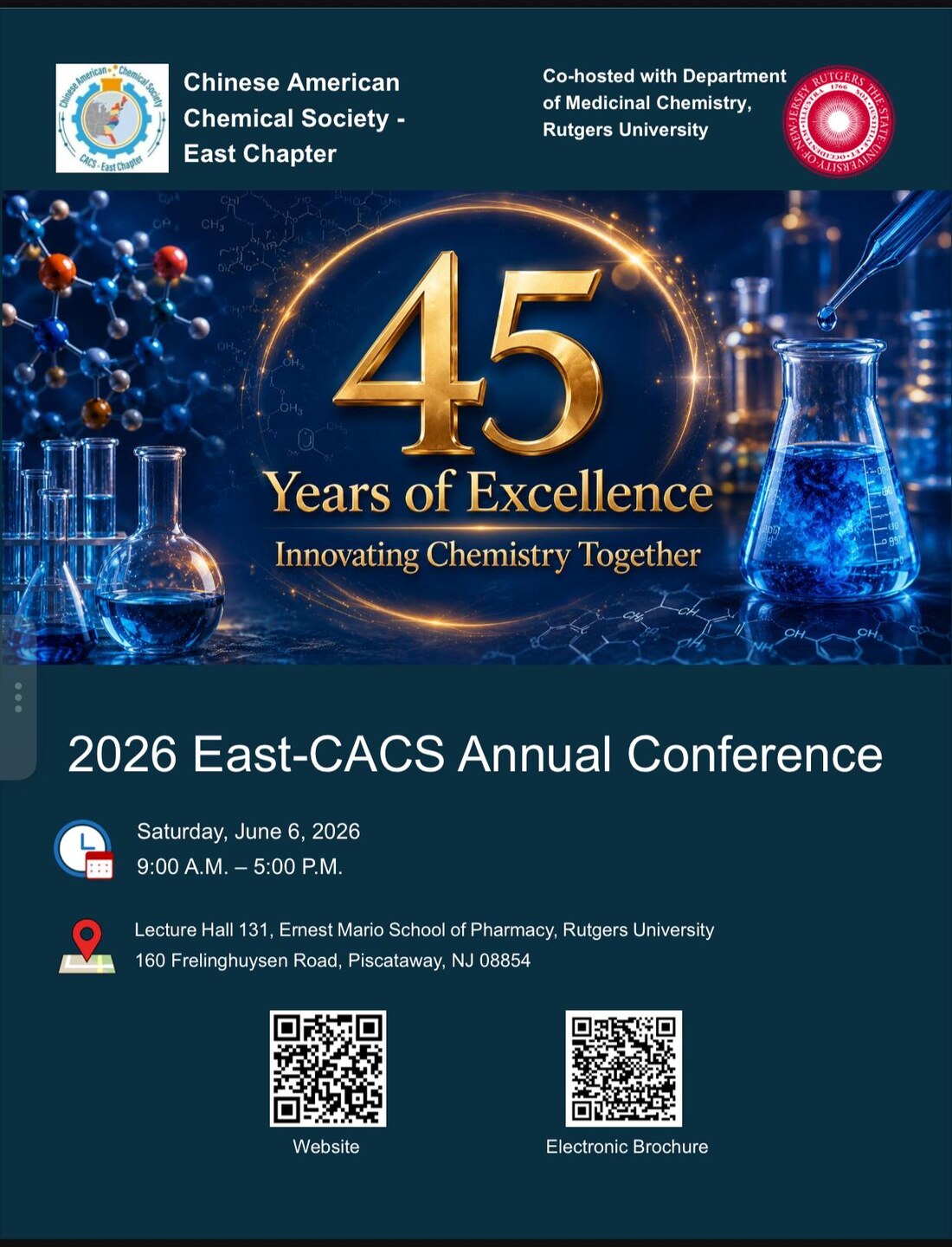
Registration Open for the E-CACS 2026 Annual Symposium
Registration is now open for the E-CACS 2026 Annual Symposium, which will be held on June 6, 2026 at Rutgers University's Ernest Mario School of Pharmacy in Piscataway, New Jersey. This year's meeting theme, "Innovating Chemistry Together: 45 Years of Excellence," celebrates both the 45th anniversary of E-CACS and the 150th anniversary of the American Chemical Society.
The symposium will feature keynote lectures, technical sessions, poster presentations, vendor exhibitions, career development activities, and networking opportunities across a wide range of chemistry-related industries and research areas. Afternoon sessions will include topics such as consumer health & personal care innovation, AI in pharmaceuticals, medical devices, and emerging technologies. The event provides an excellent opportunity for scientists, students, and industry professionals to connect, learn about current innovation trends, and expand professional networks.
The full symposium brochure, program details, and registration information are available on the E-CACS website.
Member Highlight — Lijuan Wang, PhD
Head of Small Molecule DMPK, Alexion AstraZeneca Rare Disease

Dr. Lijuan Wang leads the Small Molecule Drug Metabolism and Pharmacokinetics (DMPK) group within Small Molecule Research (SMR) at Alexion AstraZeneca Rare Disease in New Haven, Connecticut. DMPK plays a critical role in the drug discovery and development process by guiding the safety and efficacy evaluation of new molecular entities (NMEs). Her team supports lead identification, candidate optimization, IND-enabling studies, and non-clinical development and regulatory submissions for small molecule programs.
Over the years, Dr. Wang has contributed to the development and regulatory submissions of multiple NMEs, including Danicopan (Voydeya), Eliglustat (Cerdelga), Teriflunomide (Aubagio), and Firocoxib (Equioxx for horses and Previcox for dogs).
Dr. Wang received her Bachelor's and Master's degrees in Organic Chemistry from Lanzhou University and her Ph.D. in Organic Chemistry from Iowa State University. She also completed postdoctoral training at the American Health Foundation in Chemical Toxicology and at Cornell University in Biomedical Sciences. She has more than 20 years of pharmaceutical industry experience at Sanofi and Alexion.
An ACS member for more than 20 years, Dr. Wang has also been an active member of the CACS-East Chapter (E-CACS) for many years. Outside of work, she enjoys walking, cooking, talking with friends, and volunteering with E-CACS. Read more
What's New in Chemistry
Academic News
Pharmacokinetic assessment in therapeutic antibody discovery and lead optimization
Contributor: Xiaozhou Feng
A new study from Novartis and The Jackson Laboratory provides the most comprehensive evaluation to date of the human FcRn transgenic mouse models Tg32 and Tg276 for predicting the pharmacokinetics (PK) of therapeutic antibodies in humans. Using a large integrated dataset of 134 molecules, including monoclonal, multi-specific, and half-life extended antibodies, the authors demonstrate that both models accurately predict antibody clearance and half-life in humans and non-human primates. Notably, the Tg276 hemizygous model performed comparably to, and in some cases better than, the widely used Tg32 model and cynomolgus monkeys, particularly in predicting clearance. The study also establishes model-specific allometric scaling exponents and confirms that distinct scaling factors are required for half-life extended versus non-extended antibodies. Importantly, the authors report for the first time that introducing the SCID mutation into the Tg276 model effectively eliminates anti-drug antibody responses without compromising predictive performance. Because Tg276 mice exhibit faster antibody clearance, they may be especially valuable for rapid lead selection and optimization of long-acting therapeutic antibodies. Overall, these findings support the use of humanized FcRn mouse models as robust and ethically preferable alternatives to non-human primates for early-stage antibody PK evaluation and translational drug development. Read more
A New Way to Represent Molecules for AI Modeling
Contributor: Fan Li
Every molecular AI model starts with the same translation problem: how do you turn a chemical structure into a list of numbers a machine can read? Atoms, bonds, rings, and three-dimensional shape all carry information, and squeezing it into a fixed-length vector is a real design choice. That vector is called a molecular fingerprint, and it quietly sits at the bottom of nearly every molecular AI workflow, from searching for similar compounds to predicting properties to navigating chemical libraries toward a target. The quality of the fingerprint silently caps what comes after.
For decades, the default has been the Morgan fingerprint. It works by walking through the molecule, noting the chemical environment around each atom (which atoms are nearby, what bonds connect them), and packing those patterns into a fixed-length vector using a step called hashing. Hashing is a fast trick for assigning each pattern to a slot, but it has a cost: different chemical environments can land in the same slot and overwrite each other. Some information is always lost, and the smaller the fingerprint, the worse the loss. That matters because some of the most powerful molecular search techniques need short fingerprints to run efficiently. The methods that should benefit most from a high-quality representation end up using fingerprints in the regime where they work worst.
A recent preprint from Pascal Friederich's group at the Karlsruhe Institute of Technology (KIT) proposes a different approach, borrowed from a field called hyperdimensional computing (HDC). HDC represents information as very long random vectors and combines them through a small set of algebraic operations that preserve, rather than scramble, the underlying structure. Applied to molecules, the new method (called hyperdimensional fingerprints, or HDF) builds a vector for each atom from a small dictionary of atomic features, lets each atom absorb information from its neighbors over several hops, and combines everything into a single fingerprint. The whole process is fast, deterministic, and requires no training, just like Morgan.
The practical payoff is twofold. Because HDF is a drop-in replacement, any team using classical fingerprints today can swap it in without changing the rest of their workflow. More importantly, HDF holds onto its accuracy at very small fingerprint sizes, where Morgan effectively reduces to random guessing. In closed-loop autonomous discovery, where AI suggests molecules to test and the lab feeds back results, short fingerprints are essential for efficient search. With HDF, optimizations that were previously intractable can finish in hours instead of days. The authors have released a Python package, making it easy for practitioners to try.
The broader lesson is the most interesting part. The information loss long accepted as inherent to molecular fingerprints turns out to be a property of the hashing step, not of the fingerprint paradigm itself. Decades of molecular AI have been built on top of a default whose quiet limitation we now know how to remove. If that idea generalizes beyond the benchmarks in the paper, it is a small but consequential rethink of the foundation underneath nearly every molecular AI model in use today. Read more
Industry News
Molecular AI
Contributor: Fan Li
The past month brought steady progress on several practical fronts in molecular and polymer AI. Polymer informatics, long fragmented and behind small-molecule tooling, picked up new frameworks for formulation design, multi-scale simulation, and systematic polymerization, though much of the infrastructure remains hand-rolled. Agents and large language models began moving from novelty to working components of molecular workflows, with new benchmarks emerging to measure how far they can be trusted. Two threads ran underneath: the work it takes to make industrial reaction data AI-consumable, and the renewed recognition that in data-scarce regimes, well-chosen domain priors still outperform bigger generic models.
Here are some notable papers that illustrate these threads.
- A liquid handler and a UV-Vis plate reader, driven by a single Python framework, prepare and characterize 96-well plates of thermoresponsive copolymer formulations in parallel. The resulting dataset trains an ML model that proposes new formulations, which the same setup verifies in a closed loop. The case shows that capital-intensive end-to-end robotics is not a prerequisite for narrowing the model-experiment gap, and that repurposed off-the-shelf biotech instruments cover a useful range of polymer workflows. Read more
- The polymerist toolkit replaces fragmented, chemistry-specific polymer scripts with a graph-theoretic formalism: reactions become bond maps between molecular graphs that respect conservation, valence, and minimality. A single template covers an entire polymerization class, the DISCERNMENT solver enumerates which monomers can react under a given mechanism, and the PINPRICS detector flags ring piercings before MD. The framework demonstrates immediate utility on crosslinked polyamides assembled from multi-functional aromatic monomers. Read more
- MolMem extends agentic molecular optimization with two persistence layers borrowed from how coding agents work: a ChEMBL-indexed memory supplying grounded reference molecules, and a skill bank distilling reusable editing strategies from training, both activating only when the agent stalls. A 1.5B-parameter model trained this way reaches 90% success on single-property and 52% on multi-property optimization tasks, outperforming chemistry LLMs four to five times its size. The distilled skill bank also converges on edits a medicinal chemist would recognize. Read more
- MolViBench fills a gap left by general coding benchmarks that ignore chemistry and chemistry benchmarks that ignore code, evaluating frontier LLMs across 358 cheminformatics tasks at five cognitive levels. The best model reaches 39.7% first-pass on L1 single-API recall, but no model exceeds 10% on L5 end-to-end pipelines. Letting models repair their own runtime errors consistently helps, while Coder + Tester pairings boost weaker models and disrupt stronger ones, giving R&D teams a map of where to trust, verify, and supervise LLMs for molecular work. Read more
- Roche's DUCK database transforms ~700K ELN records spanning 2010 to 2024 into a queryable, AI-ready corpus via PostgreSQL with an RDKit cartridge, atom-mapping, and a three-level reaction hierarchy. The exercise reveals what raw ELNs hide: real failure rates of 4–5% even for trusted couplings, 7× more reactions from medicinal chemistry than from development, and four reaction superclasses covering 71% of all activity. The paper is a rare industrial reference for both the architecture and the hard-won lessons behind building an AI-consumable reaction corpus. Read more
- A 12-digit, hand-built molecular fingerprint for 2D Dion-Jacobson perovskite organic spacers drives an inverse design workflow that targets specific HOMO/LUMO energy alignments. Iterative chemical transformations from a single seed generate roughly five million candidates and recover all 21 published spacers along the way; because the fingerprint is invertible, the workflow constrains descriptors to a target alignment and enumerates matching structures directly, sidestepping brute-force screening. After feasibility filters and DFT validation, 56 new candidates with targeted band alignments emerge, showing how a sharper, narrower representation can outperform generic alternatives where data is scarce. Read more
Cosmetics & Personal Care
Contributor: Guangru Mao
AI-Powered Discovery Drives Growth in Online Skincare Sales
A recent industry report projects skincare will account for nearly 40% of beauty e-commerce sales by 2030, with generative AI becoming an increasingly important tool in product discovery. Unlike fragrance or color cosmetics, skincare relies heavily on technical claims, ingredient comparisons, and problem–solution positioning, making it particularly suitable for AI-assisted search and recommendation systems.
Consumers are increasingly using digital tools to evaluate ingredients, efficacy claims, and personalized solutions for concerns such as acne, aging, and pigmentation. The trend suggests brands with strong scientific communication and clear claims substantiation may gain an advantage as AI-driven shopping and recommendation platforms continue to evolve. Read more
in-cosmetics Global 2026 Highlights Wellness, Biotechnology and Healthy Aging Trends
in-cosmetics Global 2026, held in Paris from April 8–10, delivered its largest turnout to date, attracting more than 12,500 attendees and over 1,000 exhibitors from around the world. The exhibition highlighted the continued growth and globalization of the cosmetics and personal care industry, with strong participation from ingredient suppliers, formulators, and beauty brands across Europe, Asia, and North America.
Major trends at the show included biotechnology-derived ingredients, sustainability, microbiome and skin health research, and the expanding "beauty-from-within" category. Nutricosmetics, ingestible beauty products, and wellness-oriented skincare concepts received significant attention, alongside multifunctional actives targeting hydration, pigmentation, and healthy aging. AI-assisted formulation development and science-driven product positioning also emerged as growing themes, reflecting the industry's increasing focus on personalized, high-performance, and wellness-centered beauty innovation. Read more
NYSCC Suppliers' Day 2026 Offers a Window into Current Supplier Innovation
NYSCC Suppliers' Day 2026 was held on May 19–20 at the Javits Center in New York City. While a full post-show report is not yet available, HAPPI Magazine's show page offers a useful snapshot for readers who did not attend in person.
The page highlights multiple suppliers' exhibits and featured technologies, giving readers a way to browse what was shown on the exhibition floor. The showcased innovations reflect several active directions in cosmetic science, including new active ingredients, formulation platforms, sensory and texture solutions, hair and scalp care technologies, sustainability-focused materials, and wellness-oriented beauty concepts. For newsletter readers, this provides a practical overview of supplier-side innovation and a convenient entry point to follow up on technologies relevant to their own product development areas. Read more
Process & R&D Innovation
Contributor: Yanpeng Hou
Biocatalysis Enables Scalable Production of Complex Drug
Merck & Co. researchers have developed an advanced biocatalytic manufacturing route for enlicitide, a large macrocyclic peptide drug candidate designed to lower cholesterol by targeting PCSK9. Unlike current therapies that require injection, enlicitide has the potential to be delivered orally, improving patient accessibility.
The molecule's size and structural complexity posed a major hurdle — early synthesis required around 70 steps and produced only milligram quantities, making scale-up impractical. To address this, the team engineered a suite of 13 enzymes that assemble the molecule through three coordinated biocatalytic cascades. This approach eliminates chromatography and enables efficient multi-kilogram production.
Beyond solving a manufacturing bottleneck, this work highlights a broader shift in pharmaceutical process development. While biocatalysis has traditionally been applied to small molecules, this study demonstrates its capability for large, complex peptides, using challenging enzyme classes such as ATP-dependent ligases.
Overall, the advance underscores the growing role of biocatalysis in enabling scalable, sustainable production of next-generation therapeutics, particularly as drug modalities continue to increase in size and complexity. Read more
AI Enables Chemists to Design Molecules Using Natural Language
A new artificial intelligence system, Synthegy, is transforming how chemists design molecules by allowing them to describe their goals in simple, everyday language. Developed by researchers at EPFL, the system combines traditional computational chemistry with large language models (LLMs) to guide synthesis planning and reaction analysis more intuitively.
Traditionally, designing complex molecules requires years of expertise, as chemists must carefully map out multistep reaction pathways through a process known as retrosynthesis. While existing computational tools can generate many possible routes, they often lack the strategic judgment of experienced chemists. Synthegy addresses this gap by evaluating these pathways against user-provided instructions — such as prioritizing certain reaction steps — and ranking them based on how well they align with the desired strategy.
Beyond synthesis planning, the system also analyzes reaction mechanisms by breaking them into fundamental electron movements and assessing their plausibility. By incorporating expert input in natural language, Synthegy can refine predictions and explore more realistic reaction scenarios. In validation studies, its assessments aligned with chemist evaluations about 71% of the time, demonstrating strong potential as a decision-support tool.
Rather than replacing chemists, Synthegy serves as a collaborative tool that enhances human decision-making. This approach could accelerate drug discovery, improve reaction design, and make advanced computational chemistry tools more accessible to a broader range of scientists. Read more
Pharma and Biotech
EU Regulators Back Novo Nordisk's Wegovy Pill for Weight Loss
Contributor: Chongsong Xu
Novo Nordisk's oral Wegovy pill (semaglutide 25 mg, once-daily) received a positive EU regulatory recommendation for weight management — a major milestone as the first oral GLP-1 therapy to do so in Europe. Clinical data showed ~16.6% mean weight loss, comparable to the injectable version, with a third of patients losing 20%+ bodyweight. The cardiovascular benefit data (SELECT study) is also included in the label. The pill already launched in the US in January 2026 and crossed 1 million users in just four months, signaling strong demand. EU market launches are expected in H2 2026.
Bottom line: This expands Wegovy's already formidable moat — adding a more convenient oral option to an injectable already approved for weight loss, cardiovascular risk reduction, heart failure, osteoarthritis, and NASH. Read more
UCB Bets on Regenerative Neuroscience with Neurona Acquisition
Contributor: Jiatong Liu
Neurona Therapeutics is a clinical-stage biotechnology company developing regenerative cell therapies for neurological disorders, with an initial focus on drug-resistant epilepsy. Founded out of stem cell research from the University of California, San Francisco (UCSF), the company specializes in generating inhibitory interneurons derived from pluripotent stem cells. These cells are designed to restore the balance between excitatory and inhibitory signaling in the brain — a core dysfunction underlying many forms of epilepsy.
Its lead program, NRTX-1001, is being evaluated in patients with mesial temporal lobe epilepsy (MTLE), one of the most common and difficult-to-treat forms of focal epilepsy. Early clinical data have attracted attention because the therapy has shown the potential to significantly reduce seizure frequency after a single administration, raising the possibility of a durable or even disease-modifying effect rather than chronic symptom management.
Why UCB Acquired Neurona. UCB's interest in Neurona likely stems from both strategic fit and platform potential. UCB is already a major player in epilepsy through established anti-seizure medications, but most current therapies only control symptoms and many patients remain refractory to treatment. Neurona offers a fundamentally different mechanism: repairing dysfunctional neural circuitry through regenerative medicine. This gives UCB exposure to a potentially transformative treatment modality that could redefine long-term epilepsy care.
The acquisition also provides UCB with an entry point into the broader regenerative neuroscience space, which remains relatively underpenetrated by large pharma. Importantly, Neurona is not just a single-asset company; its interneuron replacement platform could theoretically be expanded into other neurological conditions involving circuit imbalance, including Parkinson's disease, neuropathic pain, and psychiatric disorders.
From a competitive standpoint, UCB may also be acting early to secure differentiated innovation before meaningful clinical validation drives valuations significantly higher. As neuroscience becomes increasingly competitive again, especially around advanced modalities like gene and cell therapy, acquiring Neurona now allows UCB to strengthen its leadership position in epilepsy while building longer-term optionality in regenerative neurology. Read more
FDA Pushes for "Real-Time" Clinical Trials to Modernize Drug Development
Contributor: Jiatong Liu
The FDA announced a major initiative to accelerate the adoption of "real-time" clinical trial models aimed at modernizing how clinical evidence is generated and reviewed. The effort focuses on integrating technologies such as electronic health records (EHRs), wearable devices, remote monitoring tools, and digital data capture systems to enable more continuous, efficient, and adaptive clinical trials.
The agency framed the initiative as part of a broader push to reduce inefficiencies in traditional trial infrastructure, improve patient participation, and shorten development timelines. By leveraging real-world and near real-time data streams, the FDA hopes to support faster evidence generation while maintaining regulatory rigor. The announcement also signals increasing openness toward decentralized trial designs and AI-enabled data analysis in future regulatory workflows.
Our Takeaway. This announcement reinforces a growing regulatory shift toward more digitally integrated and operationally flexible clinical development models. For the biopharma industry, the FDA is effectively signaling that future competitive advantage may depend not only on therapeutic innovation, but also on the ability to generate, monitor, and analyze clinical data more efficiently in near real time.
The move is particularly important for companies developing therapies in areas with long trial timelines or difficult patient recruitment dynamics. Real-time monitoring and decentralized infrastructure could materially lower operational costs, improve retention, and accelerate readouts — especially in rare disease, oncology, and chronic disease studies.
At the ecosystem level, the initiative also creates tailwinds for clinical trial technology vendors, digital biomarker platforms, remote monitoring providers, and AI-driven data infrastructure companies. Over time, the distinction between "clinical trial data" and "real-world data" may continue to blur, with regulators increasingly accepting continuous longitudinal patient data as part of the evidentiary framework for approvals and post-market surveillance.
More broadly, the FDA's messaging suggests regulators are becoming more proactive in shaping next-generation drug development infrastructure rather than simply evaluating end results. That could accelerate adoption of decentralized and AI-enabled trial models across the industry over the next several years. Read more
BMS Deepens China Innovation Push Through Hengrui Partnership
Contributor: Jiatong Liu
Bristol Myers Squibb (BMS) and Hengrui Pharma announced a strategic collaboration across oncology, hematology, and immunology, further highlighting growing multinational interest in China-originated drug innovation. The partnership gives BMS access to multiple Hengrui assets while strengthening its external innovation pipeline in highly competitive therapeutic areas.
Hengrui & BMS China Positioning. Hengrui has emerged as one of China's leading innovative pharma companies after years of transitioning away from a traditional generics-focused model. The company has built a broad pipeline spanning oncology, immunology, ADCs, and next-generation IO therapies, and has become increasingly active in outbound licensing to global pharma.
Recent momentum around Chinese biotech innovation was further reinforced by the IPO of Kailera Therapeutics — a metabolic disease company backed by Hengrui-originated assets — which drew strong market attention and highlighted growing investor appetite for China-developed pipelines with global potential. The transaction underscored how Chinese pharma companies are increasingly monetizing innovation through overseas partnerships and capital markets rather than relying solely on domestic commercialization.
The deal also offers clues into BMS's future pipeline priorities. BMS appears increasingly focused on sourcing next-generation oncology and immunology assets externally, especially in areas such as ADCs, multi-specific antibodies, and differentiated IO combinations where Chinese companies have become globally competitive. Hengrui is attractive not only because of its broad pipeline, but also because of its ability to rapidly advance assets through clinical development with comparatively efficient cost structures.
Our Takeaway. The BMS-Hengrui partnership reflects a broader structural shift in global biotech: China is increasingly becoming integrated into mainstream global drug development rather than operating as a separate regional market. Large pharma companies are becoming more aggressive in sourcing innovation from Chinese developers, particularly in oncology and immunology where development speed and cost efficiency matter more than ever.
More broadly, the deal suggests cross-border licensing and partnership activity between multinational pharma and Chinese biotechs is likely to continue accelerating as global companies look for differentiated assets and more capital-efficient R&D strategies. Read more
Sponsor Highlight — Precise PEG

E-CACS greatly appreciates Precise PEG's generous silver sponsorship!
Advancing Bioconjugation and Drug Discovery with Precise PEG LLC
Precise PEG LLC specializes in PEGylation reagents, bioconjugation tools, and custom synthesis solutions supporting pharmaceutical, biotechnology, and academic research. With laboratory operations in Delaware and China, the company develops functional PEG linkers, ADC linkers, PROTAC and targeted protein degradation (TPD) building blocks, PEG-lipids, click chemistry reagents, and other advanced research materials.
As therapeutic modalities such as ADCs, TPDs, and radiopharmaceuticals continue to expand, Precise PEG has invested in specialized linker technologies and custom synthesis capabilities ranging from milligram research quantities to kilogram-scale manufacturing. The company also maintains strong analytical and quality-control capabilities, including HPLC, LC-MS, GC-MS, and NMR, to support reproducibility and product reliability. In addition, Precise PEG is expanding into PEG alternatives such as polysarcosine (pSar) to support next-generation drug delivery and bioconjugation strategies.
To learn more about Precise PEG's products and services, please visit www.PrecisePEG.com or follow the company on LinkedIn, where it regularly shares promotions and scientific white papers. Read more